TL;DR: Krill oil supplies the omega-3s EPA and DHA, mainly in phospholipid form. Compare the amounts per actual serving, not the headline oil weight. Research on absorption is interesting but does not prove that every krill product produces better health outcomes than fish oil. Krill are crustaceans, so allergy and medication questions matter before choosing a product.
What makes krill oil different?
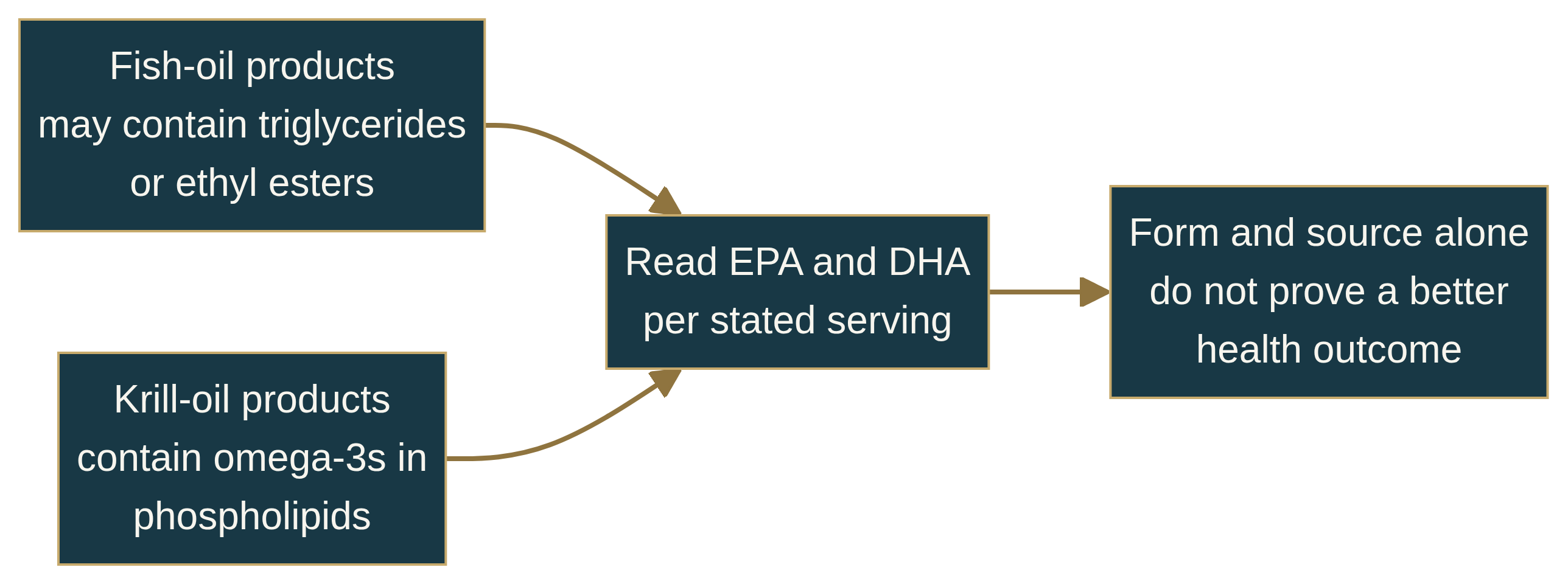
Krill are small marine crustaceans. Their oil supplies eicosapentaenoic acid (EPA) and docosahexaenoic acid (DHA), two long-chain omega-3 fatty acids. In krill oil, omega-3s are carried largely as phospholipids; many fish oils carry them mainly as triglycerides. The carrier is part of the molecule, not a separate amount of EPA or DHA to add to the label. See NIH’s overview of omega-3 sources and our EPA vs DHA basics explainer.
Krill oil can also contain astaxanthin, a reddish pigment. Its presence does not prove a capsule is fresh or that it has a specific health benefit. A published overview of omega-3 oxidation, written by authors associated with the omega-3 industry, discusses both the pigment and the difficulty of testing colored oils.
Read the label without double-counting
Start with the Supplement Facts serving size. A serving might be one softgel or several, and the manufacturer’s serving is not a personalized dose. FDA explains that supplement serving sizes are set by manufacturers and that the panel lists amounts per serving.
Imagine a hypothetical two-softgel serving lists 1,000 mg of krill oil, 120 mg EPA and 60 mg DHA. It provides 180 mg EPA plus DHA per serving, or 90 mg per softgel. The 1,000 mg is oil weight, not the omega-3 total. If the panel also lists 400 mg phospholipids, do not add that figure to 180 mg: the quantities describe overlapping things, not separate omega-3 servings. This example is not an intake recommendation.
To compare two products, write down:
- Serving: number of softgels and servings per container.
- EPA and DHA: each amount, plus their sum if both are disclosed. Total omega-3s may include other fatty acids, so it need not equal that sum.
- Other ingredients: capsule material, flavors, added nutrients and allergen information.
- Cost basis: price divided by servings per container; then compare that cost alongside EPA plus DHA per serving, not the price of a bottle alone.
If EPA or DHA is not stated, mark it not disclosed, rather than zero or an estimate from the oil weight. Our omega-3 label walkthrough provides more examples. The comparison tool can put listed details side by side; confirm the current manufacturer label and make sure serving bases match.
What absorption studies actually show
A 2026 randomized trial followed 72 healthy adults who completed 12 weeks on one krill oil or one fish oil product. With roughly comparable, but not identical, EPA and DHA amounts, the krill group had larger increases in plasma EPA and DHA. The trial was publicly funded; the krill capsules were supplied by their manufacturer.
That result concerns blood concentrations, not a demonstration that krill prevents disease better. It tested specific products in healthy adults over a limited period. Different formulas, food intake and study methods may produce different results, and a phospholipid claim alone does not predict the response to every bottle. NCCIH notes that evidence for seafood and evidence for supplements are not interchangeable. Prescription omega-3 medicines also differ from typical supplements in formulation, testing and regulation; do not replace a prescription with krill oil on your own.
Allergy, medicines and family use
Krill are crustaceans. If you have a shellfish allergy, avoid krill oil unless your allergist or clinician determines the specific product is appropriate. Read the complete ingredient list and ask about cross-contact when it is unclear; a lack of a warning is not assurance of safety. FDA’s allergy guidance explains allergen labeling and why serious reactions need prompt attention.
Tell a clinician or pharmacist about the supplement if you take medicines, especially anticoagulants such as warfarin. NIH ODS notes that high doses of omega-3s can cause bleeding problems with anticoagulants. Discuss individual use during pregnancy or breastfeeding, and ask a pediatric clinician before giving a supplement to a child; an adult serving is not a child’s recommendation.
For families who eat fish, FDA and EPA’s fish advice identifies lower-mercury choices and age-appropriate portions. It is food guidance, not a krill-oil dose. If avoiding animal-derived oil, see fish oil vs algae oil, while checking the whole algae product for ingredients and cross-contact relevant to your allergies.
Check freshness, testing and sourcing
Follow the particular bottle’s storage directions. Oxygen, heat and light can promote oxidation in omega-3 oils. A distinctly spoiled smell or damaged seal is a reason to stop using the product and ask the manufacturer, but smell, taste, color and the freezer test cannot prove freshness. Do not taste a suspect oil to test it.
If a company offers a certificate of analysis, ask for the finished product and lot, testing date, laboratory, analytes and methods. Peroxide value measures some primary oxidation products. A common secondary-oxidation test, p-anisidine, can be unreliable for colored krill oil because pigments can interfere; a TOTOX calculation using an unsuitable p-anisidine result is also questionable. Ask which method was validated for that particular oil. The industry-associated oxidation overview explains these method limits. A past report is a snapshot, not proof of a bottle’s current condition; see spotting oxidized oil.
For sourcing, ask which species and fishery supplied the oil and what any certification actually covers. NOAA describes ecosystem-based management of Antarctic marine resources, including krill; that framework alone does not establish the impact of a particular bottle. A fishery seal is not a contaminant test or evidence of effectiveness. Explore the krill oil category and verify any product-specific claim independently. FDA regulates supplements, but does not approve them for safety or effectiveness before marketing.
Sources
- NIH Office of Dietary Supplements: Omega-3 fatty acids consumer fact sheet
- NIH NCCIH: Omega-3 supplements and the evidence
- FDA: Questions and answers on dietary supplements
- FDA: Food allergies and labeling
- FDA and EPA: Advice about eating fish
- American Journal of Clinical Nutrition: Randomized krill oil and fish oil trial
- Lipid Technology: Overview of oxidation in EPA- and DHA-rich oils
- NOAA Fisheries: Antarctic Marine Living Resource Program
Frequently asked questions
Is krill oil always better absorbed than fish oil?
No universal advantage is established. Some studies find greater increases in blood omega-3 levels with particular krill products, but products, doses and methods differ, and blood levels are not the same as health outcomes.
Is the amount of krill oil the same as the amount of EPA and DHA?
No. Krill oil contains other substances as well. Add the separately listed EPA and DHA amounts for the stated serving; if either amount is missing, do not assume it is zero.
Does the phospholipid amount tell me how much EPA and DHA I get?
No. Phospholipids are a class of molecules that can carry fatty acids; the listed phospholipid amount is not the same as the amount of EPA plus DHA.
Can someone with a shellfish allergy take krill oil?
Krill are crustaceans. If you have a shellfish allergy, avoid krill oil unless your allergist or clinician determines that the particular product is appropriate; do not assume processing removes the allergy risk.
Does astaxanthin mean krill oil cannot oxidize?
No. Astaxanthin is a pigment found in krill oil, but its presence does not establish the freshness of a specific product. Follow storage instructions and ask about a product-specific testing method if needed.
Can krill oil replace a prescription omega-3 medicine?
Do not substitute it without the prescribing clinician's advice. Prescription omega-3 medicines differ from dietary supplements in composition, testing and regulation.
Does a sustainability seal prove a krill oil is pure or effective?
No. Check which fishery, chain of custody or product the particular program covers. Environmental certification is not a laboratory contaminant report or proof of a health outcome.